What we need from you
Four things, one message, about ten minutes.
When Volara funds something you do, we publish a short public report showing donors exactly what their money did. Here is what we need to write one — and why we ask.
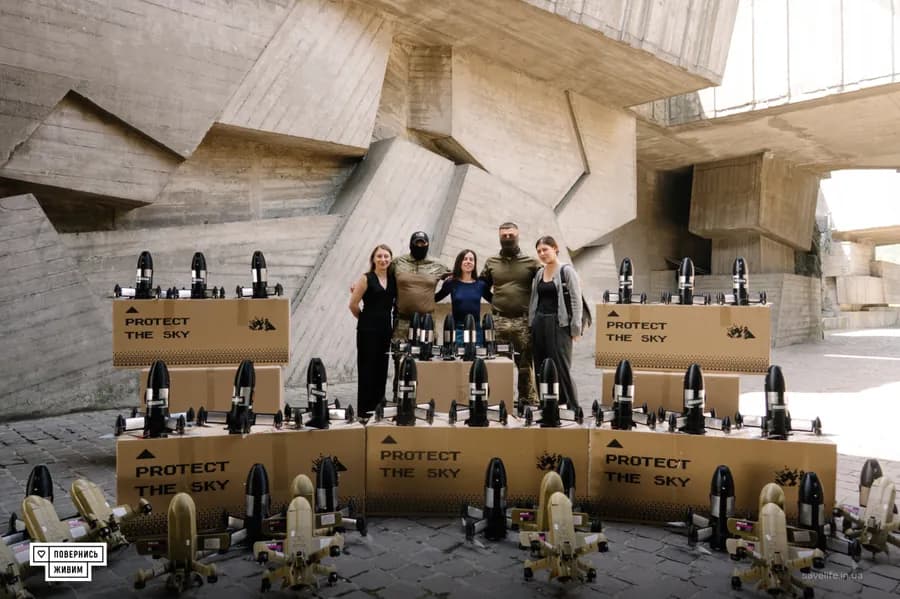
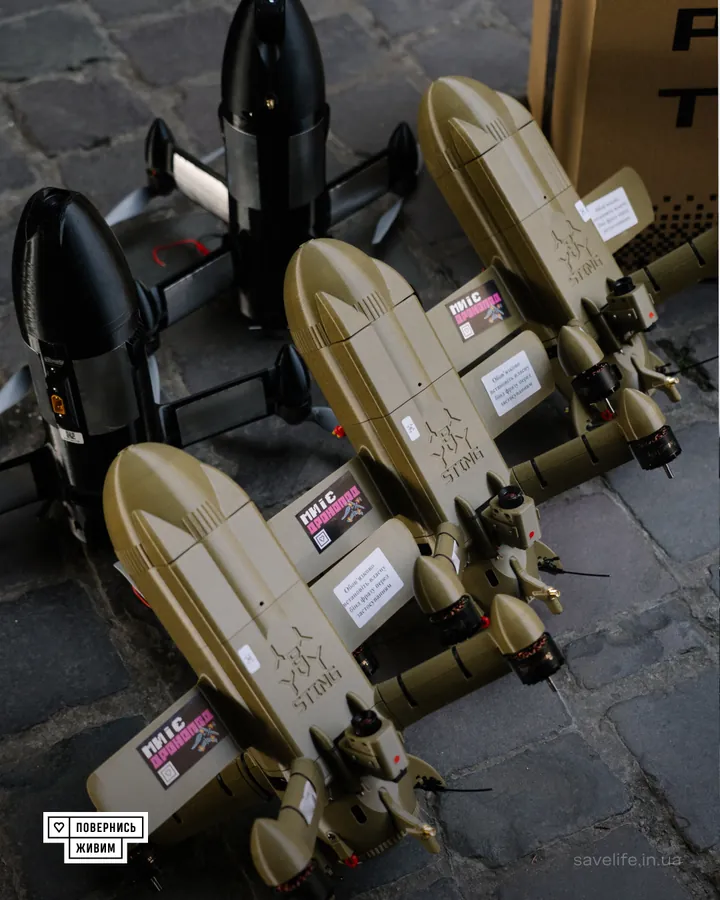
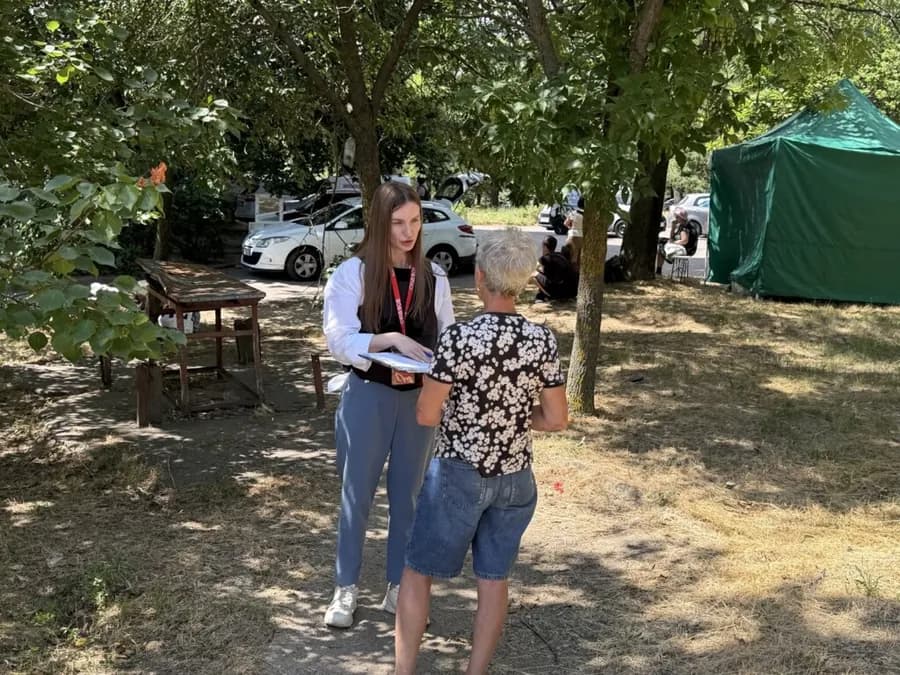
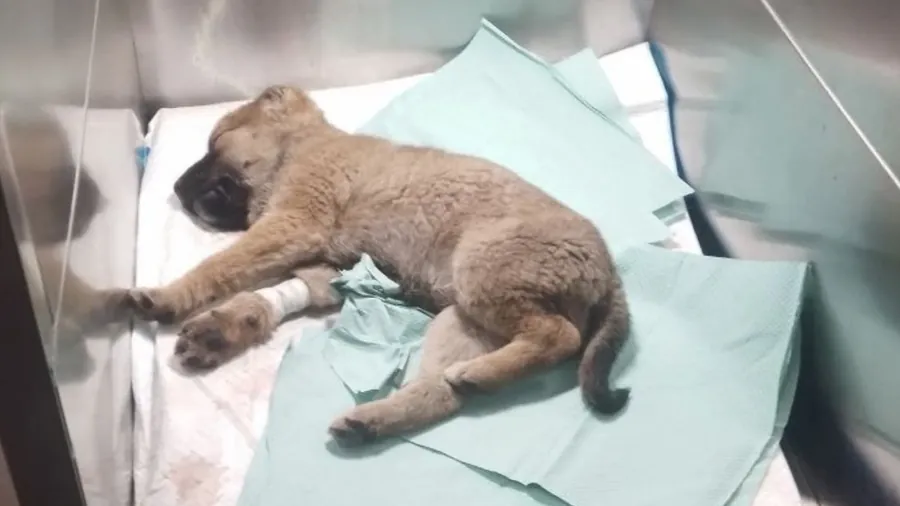
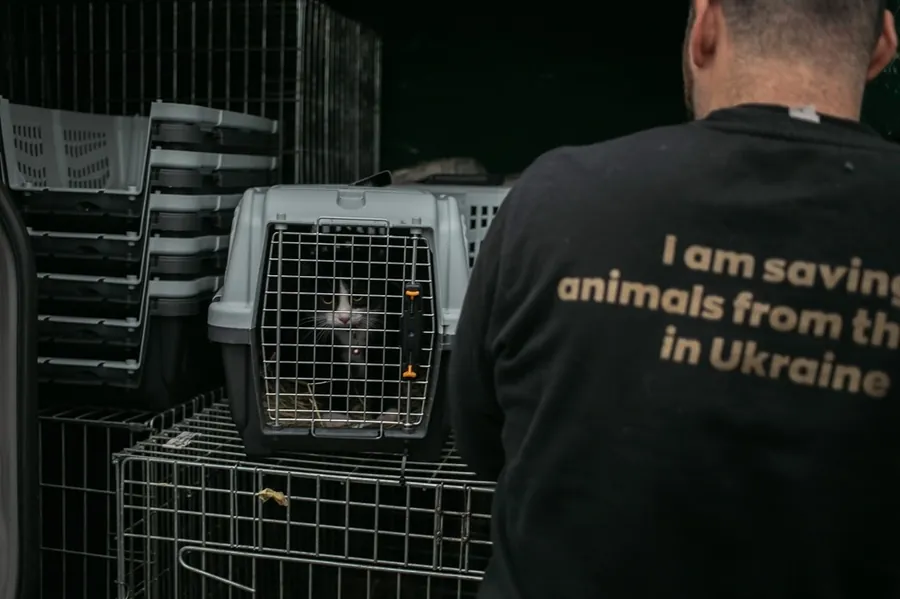
What we publish underneath: who is in it, what is happening, and roughly where.
Why this decides whether a donor gives again
This is not paperwork for our records. It decides whether a donor gives to you once, or keeps giving.
93%
of donors would give again when thanked and later shown what their gift achieved
Burk, Donor-Centered Fundraising
67.7%
must trust an organisation before giving anything at all
BBB Give.org, 2026
18.3%
actually report high trust in charities
BBB Give.org, 2026
Your own evidence is the only evidence you have.
Donors checking a large charity can read a Charity Navigator rating or an audited annual report. None of that exists for a small frontline organisation — so the photos, receipts and names you send are not one source among many. They are the whole case, and we cannot make it from a desk in another country.
The report is what raises the next round.
Donors who give twice are worth many times those who give once, and monthly donors quietly disappear when they stop seeing where their money went. Showing them, specifically, is the strongest defence there is — and that money comes back to your work.
M+R Benchmarks, 2026
How this works, and when the money follows
The same for every organisation we fund.
- 01We fund something.
- 02When it is done, you send the four things below.
- 03We write the report and publish it.
- 04Donors see it. That is what raises the money for the next thing.
Reporting comes before the next tranche
We fund in stages, and we need the material for the last stage before releasing the next. Every institutional funder works this way; we are the light version — four things and a voice note, not a twelve-page form. It applies to every partner, for one reason: we cannot ask donors for more without showing them where the last money went.
If something urgent happens, tell us. Emergency funding is never held up by paperwork.
It does not have to be you
If reporting is not your strength, nominate someone else on your team to handle it directly. That is normal, and it usually works better.
The four things that make a report publishable
The same four every time, whatever we funded. Miss one and the report either gets thinner or waits.
No forms, no written report, no English, no polish — Ukrainian voice notes are ideal, and rough photos taken today beat good ones next month.
What it cost — with real numbers
The item or the work, how many, what each cost, and the total. Plus the receipt or invoice — a photo of the paperwork is fine — and the date it was finished.
We publish these figures, so they must match reality. Unsure of a number? Tell us and we leave it out.
Proof it happened
Photos of the real thing, and any handover or delivery note. Send originals from the phone rather than screenshots, and include a few wide shots — we need one for the top of the page.
The pair we ask for
Taken from roughly the same angle. Photograph everything the day it arrives — it costs nothing then and is worth a great deal later.
What counts as proof for your kind of work
Open the line that matches your work. Ignore the rest.
▸Something was bought and handed over
Gear, medical supplies, a generator, a vehicle.
- Proof
- The items in the hands of the people who now use them.
- Who
- Whoever uses it daily.
- Watch for
- A sealed carton proves a purchase, not an outcome. We need it in use.
▸Something broken now works
A vehicle repair, a building repair, refurbished equipment.
- Proof
- Before and after photos from roughly the same angle — the most persuasive thing you can send.
- Who
- The operator or mechanic who knows what it was like broken.
- Watch for
- Nobody photographs a broken thing. Photograph everything the day it arrives — it costs nothing now and is worth a lot later.
▸An ongoing service we funded for a period
Evacuations, meals, a clinic, a shelter.
- Proof
- A log or count for the period, plus photos from different days.
- Who
- One person you helped, on one specific day.
- Watch for
- Sending only totals. Big numbers make readers feel less. Give us one day and one person.
▸A rapid response after something happened
A strike, a flood, a sudden displacement.
- Proof
- Times matter here — when the call came, when you arrived.
- Who
- A responder, or someone you assisted.
- Watch for
- Graphic imagery. The story is the response, not the damage.
▸Treatment for one person or animal
Medical care, a prosthetic, psychological support, animal rescue.
- Proof
- Confirmation the care was delivered, and the outcome later.
- Who
- The patient — only if they freely want to be.
- Watch for
- Highest consent burden of anything we publish. Medical detail is private; we anonymise unless told otherwise.
▸Your team can now do something new
Training delivered, a capability built.
- Proof
- The new skill being used — not certificates, not a classroom.
- Who
- Someone describing what they can now do.
- Watch for
- People sitting in rows. Show the skill in use.
One person, named, who will talk to us
One person closest to the work — a driver, a medic, a mechanic — willing to be named and photographed, saying two or three sentences in their own words.
A voice note in Ukrainian is perfect; we turn it into text. This is the thing we most often do not get, and the thing that matters most.
What it changed — and the evidence for it
What you have been able to do since, that you could not do before. One specific example is worth more than a summary: the run you made, the people you reached, the days of work it bought you. Then the evidence — photographs of the thing actually in use, not just delivered.
In-use and after photos are the ones we are always short of. A crate at the gate proves a purchase; the same equipment working a week later proves an outcome. Tell us the honest version too, including what is still short.
The standard that gets a donor to give twice
These are real reports published by other Ukrainian organisations. Look at how specific they are: named units, exact sums, the quantity split between recipients, the outcome months later.
Every organisation below is well known. People give to them because they have heard of them, and their reporting confirms a decision the donor had already half made. Nobody has heard of us yet — so our reports cannot merely match theirs. They have to be more specific and more thorough, because the report is doing the work the reputation would otherwise do.
You do not have to match these pages. Send us half of one and we can write something that stands next to them.
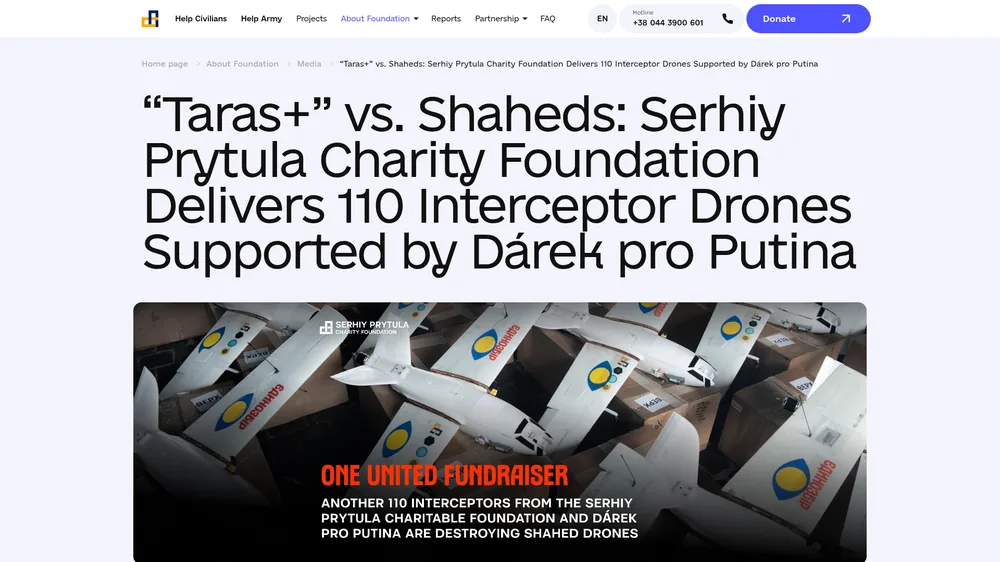
Serhiy Prytula Charity Foundation
110 “Taras+” interceptor drones delivered
Names every receiving unit and splits the quantity between them — 50 to the 31st Mechanised Brigade, 20 each to the 164th, the 201st and “Kraken” — states the exact spend (13,860,000 UAH), explains why interceptors beat missiles on cost, and links a tracker updated daily.
Read the original ↗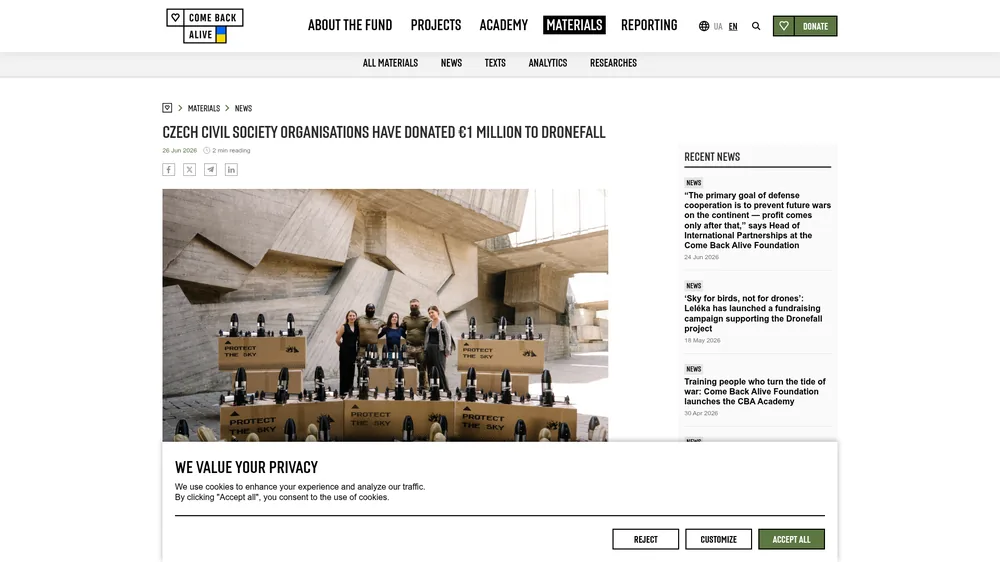
Come Back Alive
€1 million from Czech civil society to Dronefall
Credits the funders by name — Post Bellum and Skupina D — and quotes them, states the sum and exactly what it bought (550 interceptor UAVs, first batch), shows seven photographs of the delivered equipment, and reports the cumulative outcome: over 43,000 Russian drones intercepted by June 2026.
Read the original ↗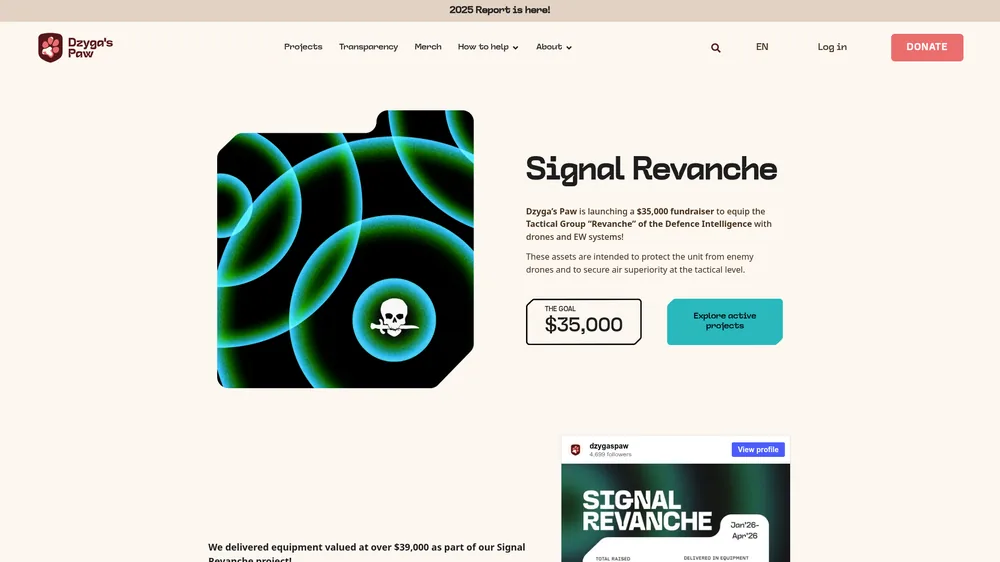
Dzyga’s Paw
Signal Revanche
Publishes the shopping list before the money is spent: an itemised “equipment to buy”, a live funding percentage, who is behind the campaign, why it matters — and last year’s full report linked from the top of the page.
Read the original ↗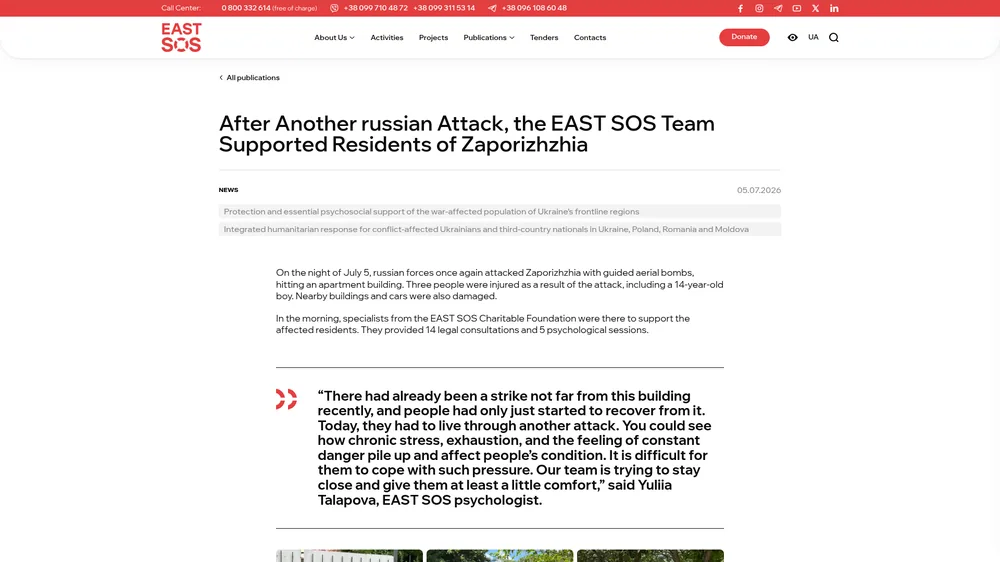
East SOS
Supporting residents of Zaporizhzhia after an attack
A rapid-response report: the exact night of the strike, the type of weapon, the building hit, and what the team did on the ground — filed while it was still news, with photographs from the site.
Read the original ↗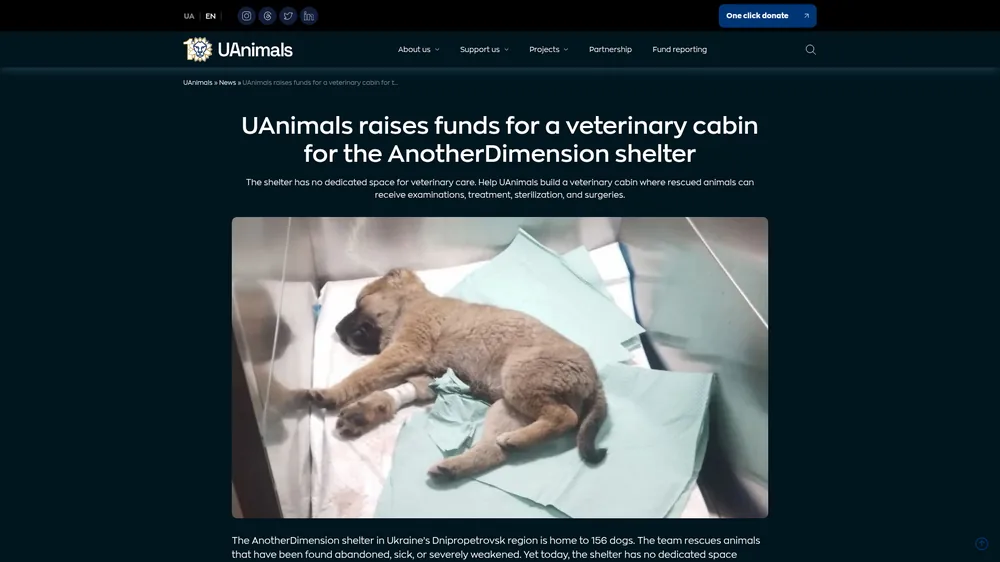
UAnimals
A veterinary cabin for the AnotherDimension shelter
States the precise sum needed — UAH 303,484 — exactly what it builds, and the situation it fixes: 156 rescued dogs at a shelter with nowhere to treat them.
Read the original ↗
A message that gives us everything
Nothing here is formal. It is one Telegram message, some photos and a voice note — but every line is specific, and that is what makes a report worth publishing. Send us as much of this as you can; half of it is still a good report.
Telegram · 09:12 · to Volara
Food delivery arrived Tuesday morning, all of it in good condition.
40 sacks of dry food, 30 kg each — 1,200 kg total. 62 UAH per kg, 74,400 UAH altogether. Receipt from the supplier attached, the itemised one rather than the summary.
That is roughly seven weeks of feeding for the 156 dogs we have at the moment.
Before this we were down to four days of food and had started mixing in whatever was donated locally. The older dogs and the ones recovering from surgery do not handle that well at all.
Olena runs the feeding here. She is happy to be named and photographed — voice note from her attached, about 40 seconds, she explains what the last fortnight was like.
Photos: 3 of the pallet at the gate as it came off the truck, 2 of the store room full again, 1 of Olena at the morning feed.
Still short of medication for the two dogs recovering from the road accident, if that is something you can look at next.
Sent with the message
Pallet at the gate
3 photos — as it came off the truck
Store room, full again
2 photos — the same shelves as last month
Olena at the morning feed
1 photo — the person quoted above
Supplier receipt
photographed — the itemised one
Voice note from Olena
40 seconds, Ukrainian — we transcribe it
Why that message works
- It gives real numbers
- Sacks, weight, price per kilo, total, and an itemised receipt — so the delivery manifest can be published exactly, with nothing rounded or guessed.
- It says what it was like before
- Four days of food left, and older dogs being fed the wrong thing. Without that, a delivery is just a receipt; with it, a donor understands what their money prevented.
- It has one named person
- Olena, with a voice note in her own words. One named person does more than any statistic we could publish.
- It shows the outcome, not just the delivery
- Seven weeks of feeding for 156 dogs, and a store room photographed full again. The receipt proves a purchase; that proves it worked.
How to send it, in about ten minutes
Everything in one message or folder — photos, voice notes, a snap of the receipt, a few lines of text. Rough and fast beats polished and late. If something is missing we will ask for that one thing. We do not need long reports, formal letters, or staged photographs of people looking distressed.